How to Play Bridge
The goal of Bridge is to score points by successfully winning the number of tricks your team bids, with the first team to reach 100 points winning the game.
Bridge Setup
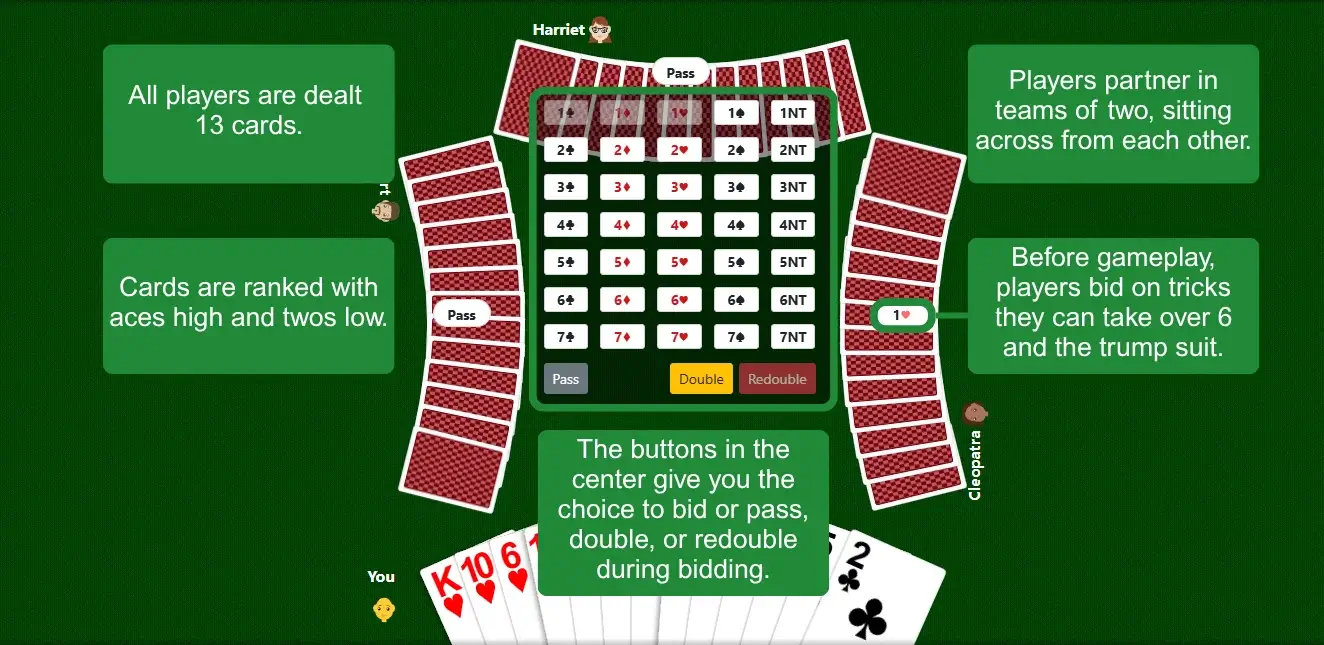
Bridge is a four-player trick-taking card game, and is set up as follows:
- Partnership: Like many trick-taking games, it’s played in teams of two. Team members sit across from each other with one partnership called We and the other called They.
- Deal: Each hand begins by the dealer dealing 13 cards to each player.
- Bidding: After the deal and before cards are played, players take turns bidding how many tricks above 6 they think their team can win and choosing a trump suit or no trump, with each bid higher than the last. The highest bidder wins the contract, setting the required number of tricks and the trump suit. To bid, click a valid option or choose pass, double, or redouble. Bids that are too low will be grayed out.
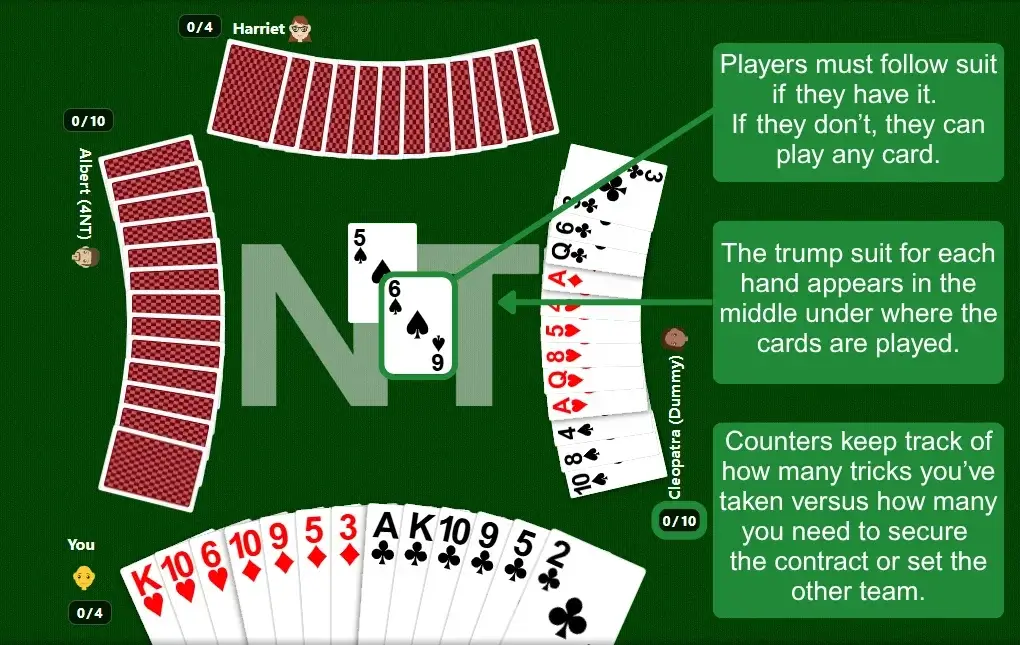
- Trick: Each hand consists of 13 tricks, and a trick consists of one card from each player’s hand being placed into the middle. Each player plays their own hand, except the dummy hand, which is played by the partner (declarer). The card of the highest rank or the highest trump card wins the trick.
- Card rank: The cards are ranked from ace to two, but trump suit outranks any other suited rank. For example, if spades is trump and the 8♥, 4♥, 7♠, and J♥ are played, the 7♠ outranks all the hearts and will win the trick.
Bridge Rules and Bidding
- After the cards are dealt, players begin the bidding phase. If all players pass on making a bid, the cards are redealt by the player to the left of the dealer.
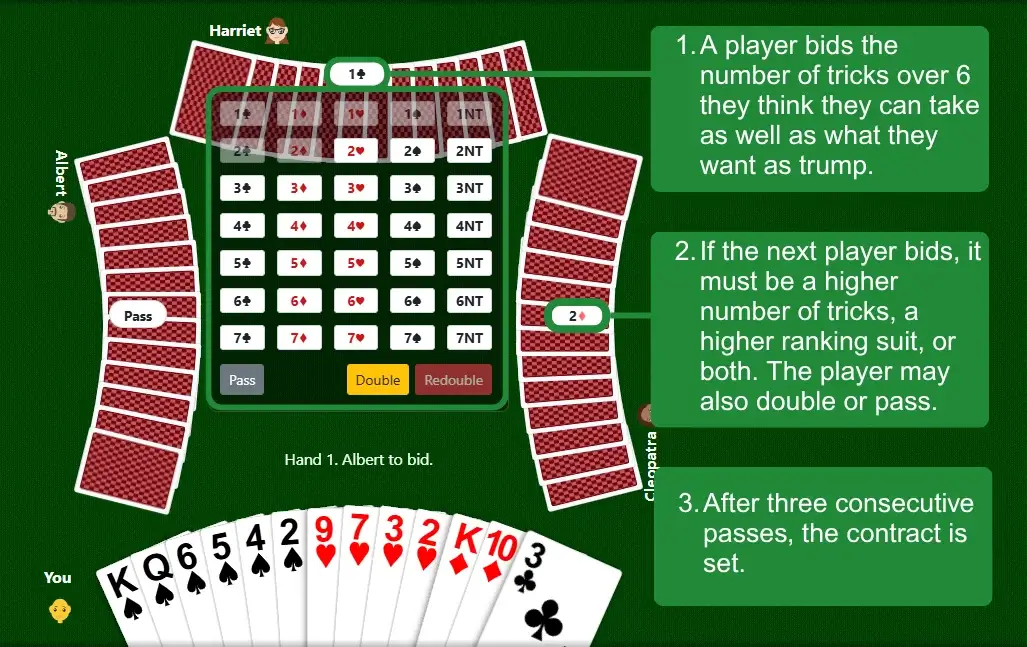
- Players take turns making bids that predict how many tricks their team will win (above 6), along with the trump suit (clubs, diamonds, hearts, spades, or no trump). Bidding starts to the dealer’s left and goes clockwise. So if you think you can take 8 tricks and want clubs to be trump, you would click, “2 clubs.”
- Each new bid must be higher than the last, either by increasing the number of tricks or choosing a higher ranking suit. Suits rank from lowest to highest: clubs, diamonds, hearts, spades, then no trump. For example, if one player bid 1♦ then another player can bid a higher number for that suit (2♦, 3♦, and so on) or the same number but a higher ranking suit, such as 1♠ or 1♥.
- A player may double an opponent’s bid to increase the scoring stakes. This doesn’t double the bid numerically (a bid of 2♥ doesn’t change to 4♥). Instead, it increases the bonus points and penalties for making or not making the bid.
- If an opponent doubles your bid, your partner can redouble to further increase the bonus or penalty.
- Three consecutive passes end bidding, and the highest bid becomes the contract. A player may pass instead of bidding, indicating they do not wish to make a higher bid. After three consecutive passes, the contract is set, establishing the target number of tricks and the trump suit for the hand.
- The bid-winning partnership becomes the declarer and the dummy hand. The player who bid the contract suit becomes the declarer, and the partner has the dummy hand. The dummy hand is revealed after the opening lead and played by the declarer.
- After bidding ends, the player to the left of the declarer plays the first card. This opening lead begins the first trick of the hand. For each subsequent trick, the trick winner leads the next trick.
- Players take turns placing a card into the center, following suit if they have it. For example, if a 10♦ led, then all players must play a diamond if they have it. If a player can’t follow suit, they can play any card, including the trump suit.
- The card of the highest rank or the highest trump card wins the trick. If a 10♦, 3♣, K♦, and 5♦ were played, the K♦ would win the trick unless clubs is trump. If clubs is trump, the 3♣ would win the trick.
- As soon as one team wins 100 points “below the line,” they win. Below the line refers to tricks won over 6 when their partnership wins the highest bid. Regardless of bonus points and no matter how many hands it takes, as long as a team accumulates 100 points below the line, they win.
Bridge Scoring
Bridge scoring is split into two areas: below the line and above the line. Below the line points count toward your winning total, and above the line points include various bonuses that influence how you bid, strategize, and play.
Below the Line
If the declarer’s team secured their contract (won their bid or exceeded their bid), they score points below the line for their bid. Each trick bid over 6 and is worth points below the line. If the team wins more tricks than they bid, those overtricks are counted above the line. So if a team bid 2 diamonds and won 8 tricks, they would score points for the 2 tricks they bid and won.
Tricks are worth:
- 20 points each if diamonds or clubs is trump
- 30 points each if spades or hearts is trump
- 40 points for the first trick and 30 points for tricks after that if no trump is the trump suit
Above the Line
Although below the line points can only be scored by the team who secured their contract, above the line points include bonuses and points that may be earned by either team.
If a team makes their contract, they may be eligible for other points beyond those scored for tricks they bid and won:
- Overtricks: Additional tricks won above the bid are called overtricks. If a team bid 8 tricks but won 9, they would have 1 overtrick. Overtricks are worth:
- 20 points each if diamonds or clubs is trump
- 30 points each if hearts or spades is trump
- 30 points each if no trump (no suit) is trump
- 100 points per overtrick, regardless of trump suit, if the opposing team doubled your bid
- Insult bonus: 50 points for making a doubled contract bonus; 100 for making a redoubled bonus
- Honors bonus: 100 points if one player holds the A, K, Q, J of the trump suit
If a team doesn’t make their contract, the opposing team receives a set bonus for each trick not made but bid by the other team (undertrick):
- 50 points per undertrick regardless of trump
- 100 points per undertrick if doubled regardless of trump
Bridge Strategies
When bidding:
- Favor high-ranking suits and no trump. Hearts, spades, and no trump score more per trick, making it easier to reach 100 in fewer hands.
- Avoid overbidding. Failing a contract gives points to your opponents and slows your progress. It’s often better to make a smaller contract than miss a larger one.
- Be cautious when doubled. If your contract is doubled, the risk increases significantly. Only continue if you’re confident you can make it, or consider adjusting your bid during the bidding phase.
- Use doubling strategically. Doubling is most effective when you are confident the opposing team cannot make their contract. It can create large swings and prevent them from reaching 100.
- Communicate through bidding. Your bids help your partner understand the strength and shape of your hand, which leads to better contracts.
When playing:
- Focus on securing your contract. You may be tempted to slough off a trick or two to keep some good cards for overtricks. But extra tricks don’t count until you make your contract, and overtricks only add points above the line, which doesn’t help you win.
- Pay attention to suit distribution. A deep suit (several cards of one suit) and high cards increase your chances of controlling tricks, especially when choosing a trump suit.
- Lead low from strength. When leading, it’s often better to start with a lower card from a strong suit. This helps you pull out other player’s higher cards in that suit, allowing you to preserve higher cards for winning later tricks and securing the lead for longer.
- Save high cards for key moments. High cards are more valuable when used to win important tricks, especially later in the hand when fewer cards remain and you can control the lead.
- Use trump strategically, not immediately. Don’t rush to play trump cards unless needed. Holding onto trump allows you to control the hand and win tricks when other players run out of a suit.
- Pay attention to what’s been played. Keep track of which suits and high cards have already been used. This helps you predict what opponents and your partner may still hold.
- Watch the dummy hand. With the dummy hand showing, it at least gives you one view of your opponent’s cards, allowing you to avoid leading cards that are easily trumped or outranked.
If you enjoy trick-taking games, you may also enjoy Euchre or Spades, and you can play them all for free on Solitaired!